Copyright 2013, Ron Minor

NOTE - No part of this blog or the link to it maybe cross posted without the permission of the blog writer!!

Copyright 2013, Ron Minor

Showing posts with label Sioux City. Show all posts

Wednesday, August 23, 2017

The Dakota and Iowa, the early years,

My first encounter with what would become the D&I (Dakota and Iowa) was oddly enough a view of their bright orange hoppers while sitting in an orthodontic exam chair. This was more than likely March or April of 1980, but like the building I was in, my the memory of the exact date is gone. I do remember a Milwaukee Road switcher moving the cars around the track beside the old Milwaukee Road freight house, though. This was probably near the end of the Milwaukee Roads cleanup of its Sioux City operations and may have been one of the last Milwaukee Road movements in the area.

Being 15 at the time, I relied on a bicycle and a 126 Instamatic camera to railfan with. Money for film and an obsession with the BN and anything ex Burlington directed my priorities elsewhere. I don't remember seeing anything more that year or have any photos of the LGE operation until the spring of 1981 when two ex-UP GP9's appeared in town with LG Everest logos on the cab sides. These two units moved those orange LGEX hoppers into the old Milwaukee east yard from South Dakota and could occasionally be seen on the ICG or CNW yard leads when they delivered cars. The BN seemed to gather up any cars from LGE when they would interchange with the CNW and ICG.

Spring of 1982 brought about a new image as the two GP9's were both repainted in a nice yellow and gray scheme similar to the old UP one they wore previously. My first encounter with the newly painted units was with LGEX 1 leading empty hoppers north out of Sioux City, Iowa during April of 1982.
LGEX 1 is slowly passing the old Milwaukee Road shop complex in Riverside, IA and will shortly cross the Big Sioux River to South Dakota.

The BN had done a massive tie replacement on the old Milw mainline out of Sioux City during the summer of 1981, but ballast and heavier rail were still in the works. The light rail is evident in the photo of LGEX 1 passing the old Milw shop complex in Riverside, IA. Within a month she would receive D&I logos along with the #2 and new acquired #3.

The spring 1983 brought a new look for the D&I. The GP20 #3 (ex BN 2019) they acquired during the 81-82 winter and the two GP 9's received chopped noses, though the GP20 was still setup to run long hood forward. The three units were often used together on the road trains and could be found on a regular basics in the old Milw east yard.

D&I #1,3,2 and an ex Milwaukee caboose, lay over in the old Milwaukee Road east yard in Sioux City, IA.

1984 revealed that additional units were added over the winter. Five ex-Milwaukee Road GP9's helped the D&I with switching duties along with the increase in train size and frequency. These units continued in their Milwaukee Road orange and black paint and road numbers with the D&I herald on the cab until the winter of 85-86. During that time they received D&I numbers 4 (ex 293), 5 (ex 328), 6 (ex 321), 7 (ex 323) & 8 (ex 303).

During 1985 thru 1987 the D&I continued on with these 8 units with up to 5 units being used on the road trains into Sioux City. December 1986 I left for the Air Force and left the railroad that I called my own. My time away brought many changes to the D&I. Increases in traffic and operations out of state brought 6 axle power to the railroad in the form of SD45's and SD39's. The years between 2012 and 2016 saw the retirement of the old Milw GP9's and the downgrading of the remaining GP9's to switcher status. Newer GP50's and GP39-2's have taken their place along with six SD40-2.

D&I 4 leads a rock train thru the old maze of tracks into the ICG yard for unloading at the cement plants served by the ICG in Sioux City.  

Five D&I units have a loaded rock train in tow thru Jefferson, SD.

Waiting for a BN core line train D&I 3 holds clear on the south leg of the wye at Elk Point, SD.

Snaking back down the CNW main from the old Milw main. D&I is taking the connecting track to the ICG main just west of the Cargill plant in Sioux City, IA.

Plenty of units for an empty rock train, but slow track means this train will take awhile to get to Hawarden. Crossing the Big Sioux river into South Dakota.
Sitting in a cold late fall rain, this is the last time I would see these units in Milwaukee Road paint. D&I 303 and 321 laying over in Sioux City.
During the winter of 85-86, the D&I completed the chop nose conversions on the ex-Milw units and changed to a black and yellow scheme. Rumor at the time was the UP took offense to the gray and yellow and forced the change. 

Parked under the car shaker in Sioux City, D&I 6,7,4 & 5 dead on a cold December day in 1986.

Saturday, February 01, 2014

Some finds in a yellow box

Moving has its disadvantages and advantages, especially went it comes to rediscovering lost or forgotten items. While going through a tote with a bunch of photo envelopes I came across a long, thin, yellow plastic slide box. This box contained a roll of 126 slides that were developed in 1986 but had been exposed during the late fall of 1981.

Now before the purist turn their noses up and scream ack, 126 Instamatic wtf, it should be told that as a 15 year old this was the best I had in a camera at the time. I wouldn't get my first 35mm until Christmas 1981 in the form of a Pentax K1000.

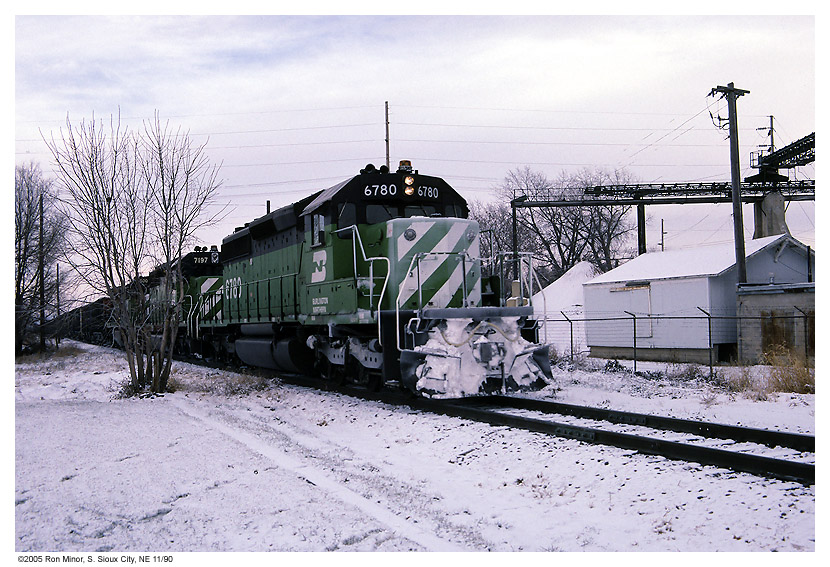
So why make a blog post on this find, it's not for the technical purity of the images, but rather for the bit of history that was captured. The late fall of 1981 was a dramatic change for the BN in my hometown. Since 1908 there has been a CB&Q/BN terminal in South Sioux City (Ferry), NE and a separate GN/BN terminal in Sioux City, IA separated by a weight restricted 1888 link pin truss bridge over the Missouri River. Starting in 1980 the BN started the process of replacing this bridge to allow for heavier trains on the Sioux City line. The opening of this bridge in Dec 1981 lead to the closing of the So Sioux City terminal and consolidation of operations into the old GN yard in Sioux City, IA.

Three clean SD40-2's lead the first revenue train across the new Missouri River bridge between So. Sioux City, NE and Sioux City, IA.

Laying over in the old Q Ferry, NE engine terminal, a set of bridge power waits for a northbound train to take across the weight restricted Missouri River bridge to Sioux City, IA.

Road power waits for their train to be dragged over from Sioux City, IA before taking over from the bridge power for the trip south.

At the old GN service track in Sioux City an unusual lashup of U33C and SD9 await service before taking a train north to Wilmar, MN. 

Some other images on this 20 shot roll include a couple of CNW and ICG shots included below for a look back. 
EMNPA power sits in the cold as their train is switched in the Sioux CIty, IA yard.

Having brought in their train earlier in the day these two GP10's rest outside the old IC engine house in Sioux City, IA. This engine house still exist as a machine shop for Cargill but the IC and GP10's are gone.


Monday, January 14, 2013

A look at the BNSF Sioux City Sub

The Sioux City sub is one of those often over looked Midwestern lines when compared to the close by BNSF Creston and Ravenna Subs and the UP's Chicago to North Platte mainline. This is rather unfortunate as this increasingly busier line has some unique character that the busier mainlines seem to lack.

History
Before beginning the exploration of this line some history is in order. The Sioux City sub was a rather late comer in eastern Nebraska. Construction of this line did not occur until 1905 when the Great Northern Railway extended the Sioux City and Western Railway to Ashland, NE from Dakota City, NE. The extension was needed to connect the CB&Q leased Sioux City and Western Railway from Ferry, NE to O'Neil, NE line. Once the line was completed the CB&Q leased what is now the Sioux City sub from the Great Northern. In 1907 the Great Northern began a process of consolidating subsidiary lines into the great Northern and in 1909 the Sioux City & Western was sold to The CB&Q.

The original route of the Sioux City Sub between Ferry, NE and Sioux City, IA was via the Pacific Short Line bridge (later known as the Combination bridge) where access to the Great Northern passenger station and freight houses along 3rd Street in Sioux City was gained.
Pacific Short Line bridge looking toward Iowa sometime in the 1890's.
Today
The BNSF Sioux City sub is a dramatically different line than it was in the early 20th century. Gone are its days of serving as a feeder line for the mainline at Ashland to its important role as a shortcut between the upper midwest and the south. Oil, sand, grain, ethanol and over head freight form the back bone of the traffic from the Dakotas and Minnesota all funneling down this non-signaled single track line. Between 14-20 trains a day play leap frog from siding to siding along this 100+ miles using TWC and creative dispatching. Some changes are in the wings for this busy line as PTC will be cut in sometime during 2013, dispatcher controlled power switches are being put into place and segments of double track are slowly being built.

Exploring the Line
Beginning from Ashland, NE heading north the various areas of the line will be outlined. The map below pinpoints specific locations and items along the line. Clicking a pin will open a pop-up with a narrative of that point of interest.


View BNSF Sioux City Sub in a larger map

Ashland to Fremont NE
Ashland NE is where the Sioux City Sub joins the Creston Sub. A wye at this junction allows for trains to head east or west on the Creston Sub. A unique feature of this junction is the presence of the Omaha Sub's junction with the Creston sub occurring between the two legs of the wye. 


An empty grain train begins its north bound journey up the Sioux City sub in Ashland NE.
Heading north from Ashland the first siding encountered will be the gravel pits owned by Western Sand and Gravel at Able and Big Sandy. These pits were once the property of Nebco and was home of the Omaha Lincoln and Beatrice inter plant railroad. Today the old OL&B line is used to store coal and freight cars.

The first town encountered north of Ashland is Yutan, NE. Yutan hosts a 4168' siding along with the at grade crossing of the UP Lincoln Sub. This crossing is protected by an automatic interlocking protecting the one M-F UP train  from Valley to Valprasio, NE.

7.5 lines north of the UP crossing is the first of the 5 important sidings along this 108 mile sub. The siding  known as Elk  is 7811' long and is used to stage trains across the UP crossing in Fremont along with south bounds meeting north bounds.

Having just meet a north bound at Elk siding this empty coaler heads for Ashland.
From the north siding switch to the UP crossing in Fremont it is 6.2 miles. About midway the sub crosses the Platte river on a plate girder bridge. From the river crossing it is around a mile and a half to the south switch to the old Fremont, NE siding. This siding is no longer used for meets and primarily serves as a storage track and to gain access to the spur into the Hormel plant at the north end of the siding.

Rounding the curve to briefly head west to the UP crossing.
After following a generally straight north alignment the line curves to the west to parallel the UP a block to the south through Fremont. Within this curve a spur heads south along the main to serve the cold storage plant across from the Homel processing plant. Both Hormel and this cold storage plant ship by rail. Refers of pork products and tank cars with tallow are the shipped out.

East of S. Main st in Fremont is the last remaining depot on the Sioux City sub. The MOW department uses the depot as offices and storage. On the west side of S. Main st the old Fremont yard is located. Interchange with the UP is done here. The Fremont to Ashland local and the Fremont to Oakland local cars are swapped on the tracks that remain.

A loaded grain train beats the UP crossing on its way south.
West of S. Main st at the north end of N. Morrell st is the BNSF-UP diamonds. BNSF trains are the lower priority at this crossing and will often wait extended periods of time before being allowed to cross the UP. BNSF crews contact the UP dispatcher for permission to cross. Once given authority they will hustle from S. Fremont or Papa to get across. Any delays typically results in the BNSF trains being "bumped" and there authority removed until the next window opens up.

A northbound loaded cement train holds the siding at Papa.
From the UP crossing it is about 2 miles to the south siding switch at Papa. Like Elk, Papa siding plays an important role in getting trains through the Fremont area, unlike Elk, Papa has industrial spurs to active customers. Five customers receive and originate loads in the area just to the south of Papa siding. Ashland Cement, Farmers Coop, Interstate Chemical, Nutri-Flow and BioEnzyme are served along the spur. At the north end of Papa siding another spur heads to CFI Industries were tank cars are unloaded.

Fremont to Oakland
Heading north out of Fremont the sub follows the Elkhorn River valley crossing it north of Winslow, NE. From this location it follows Logan Creek north through Oakland, NE.

6.9 miles northeast of Papa siding the sub crosses the FEVR's ex-CNW line at grade. This crossing is protected by an automatic interlocking but with the loss of the Diner train it is rare that an FEVR train will be encountered at this crossing.

From the FEVR crossing it is 2.5 miles to Nickerson, NE and then 5.6 miles to Winslow. Winslow used to have a small passing siding but it is now stub ended on the south end before crossing Hwy 77.

The next siding north from Winslow is a new siding that was built late 2011 south of Uehling, NE. This siding was to be the start of a segment of double tracking on the sub. It will eventually tie into the Oakland, NE siding. The distance between the two sidings is approximately 9 miles.and would give the BNSF some more room to hold trains while waiting for authority to cross the UP in Fremont. The siding at Oakland is 7420' feet but does have a crossing that can not be blocked when used.
A BN Lincoln to Sioux City train is crossing the flat farm land south of Oakland NE  during the summer of 1984.
Oakland to Winnebago
After leaving Oakland a grain shuttle loader is encountered about 1 mile from the north switch Oakland siding. This loader is setup to allow access from the north and south, but will not allow a loaded train to reverse its movement without the power running around the train. The shuttle loader is also the only customer along the sub until Dakota City, NE. This is a rather dramatic change from the 80's when every town would ship and receive cars.
An empty grain train is waiting for a fresh crew to load at the Oakland shuttle loader..
Lyons is the next town encountered from Oakland. At Lyons the sub takes a slight jog to the northwest to stay in the Logan creek flood plain which it follows until Rosalie, NE. At Rosalie the sub climbs out of the Logan Creek flood plain to the South Omaha Creek flood plain. This is a short climb of around 0.5%.

The sub follows the creek down into Walthill where an old passing siding was located.The siding is now stub ended and used for MOW storage. Just north of this siding is a hi-wide detector that protects the Gordon Drive Viaduct in Sioux City from any shifted loads or loads higher than 19'2". This high restriction prevents double stack and M3E auto racks from using the Sioux City Sub.

A southbound local running at track speed.
The next siding is at Winnebago, NE at 7590' it is the second longest siding on the sub.The Winnebago siding provides a staging spot for trains coming into the Sioux City terminal. Inbound crews will call into the Sioux City yard master asking for "landing" instructions and are typically told to call back when crossing the Missouri River bridge.

Winnebago to Sioux City
It is 27 miles from Winnebago to the terminal in Sioux City. These 27 miles can tend to be the busiest of the sub. 6.3 miles north of Winnebago is the town of Homer, NE. The old siding is still in place but has been stub ended on the south end. There does not appear to be any active shippers on this spur anymore.

It is 7.3 miles to Dakota City from Homer. In these 7.3 miles the sub crosses the Missouri River flood plain and its many old channels. There are numerous soft spots that have been shored up by driving pilings into the row on both side of the track structure. These soft spots are more pronounced during wet years as the tracks tend to sink back into the gumbo.

At Dakota City the first customer since Oakland is encountered. Elementis LTP receives inbound tank cars of chemicals that are trans loaded into tankers. A block north of them is the division point between the Twin Cities and Nebraska Divisions.The sign announcing this is a nice backdrop when out photographing.
A southbound BN grain train passes from the Minnesota Diviosion at Dakota City NE during the mid-80's.

A southbound grain train passes from the Twin Cities to the Nebraska Division.

After crossing into the Twin Cities division the sub passes through the large Tyson beef slaughter and processing plant in Dakota City. On the north side of the Tyson complex is the wye that connects the former Nebraska Northeastern/BN/CB&Q/SCWR O'niel line to the Sioux City Sub. On December 1, 2012 the BNSF completed its repurchase of this line and its new subdivision name is not known at this time.


Passing through the old Ferry yard a northbound empty grain train passes the CNW Dakota City local.
Just to the north of the this wye is the old BN/CB&Q Ferry yard and engine terminal. In 1981 the BN replaced the original 1880's bridge over the Missouri River. Prior to this trains coming north would exchange the road power with a set of GP7's or GP9's to drag the train over to the Sioux City yard. The opposite would occur for southbound trains from Sioux City.

A SC-LIN train heads south through Ferry.
Soon after the opening of the new bridge the old engine terminal and yard was reconfigured with the engine terminal removed and the yard ladder tracks off the main removed with only two tracks surviving as storage tracks.
MWILKCK passes through Ferry NE.
From Ferry to Floyd the CNW and BN shared the trackage. The line was originally owned my the CNW and was The CStPM&O mainline until the line south of Pender NE was washed out in the 1930's. After that the line was a secondary line to Emerson and Norfolk NE. The line and bridge was sold to the BN in 1975 with the CNW retaining trackage rights and ownership of the sidings in South Sioux City, NE. The UP still retains these rights today.

An empty BN coaler heads through S. Sioux City on a frozen  morning.
To cross the Missouri River the sub encounters a short grade up to the level of the bridge. On the NE side this is an incline that starts at G st in South Sioux City and at Leech Ave in Sioux City. Once a northbound train starts the climb for the bridge they call the Sioux City yardmaster for instructions. If everything is going well they get to proceed into the yard.
Coming off the bridge at G st in S. Sioux City, IA..
Starting the climb to the Missouri River bridge in S. Sioux City, Ne.
For those trains that don't have space in the yard they are held at Leech Ave. Trains are also held at Leech Ave for new crews if they are to head up into South Dakota.
Holding on the hill at Leech Ave this loaded coaler is waiting for a spot to open in the yard.
Just to the north of Leech Ave is Floyd. This jct is where the UP accesses the Sioux City for the run to Ferry and the UP Dakota City Industrial lead. Floyd also is where trains from the South Dakota lines access the Sioux City Sub. Heading north from Floyd the sub curves around the old Milwaukee Road downtown yard on a track that was built in 1956. This new track allowed GN and CB&Q trains to interchange in the GN yard on Hwy 75 instead of the original GN yard in the stock  yard district.

An empty coaler heading south out of Sioux City.

Rolling out of the Sioux City yard past the MOW staging area.
At 6th st the cross-over for the yard is located. This cross-over allows for trains to use the new pass which is a by-pass track that was build along the west side of the yard in the mid 80's to allow coal and grain trains to roll through.

Doubling over its inbound train the Sioux Falls local passes the grain elevators just south of the Sioux City yard.
The BNSF yard is located on the west side of old Hwy 75 between 18th St and 31st St. The city opened a new under pass about 2 miles north of 31st St and since then the BNSF has been blocking this crossing for extending periods of time. The yard office and MOW departments share the old GN freight house located off of 18th St.This is a busy area and is BNSF property. One should not venture into the yard office area without an expectation of being confronted.

Railfaning the Sioux City Sub.
Though Hwy 77 parallels the line from Fremont to Sioux City the sub is often away from the road. The highway is the best to use when getting from one point to the next in a fairly quick time. To explore the line in depth the many country roads (paved and gravel) are the best way to railfan the sub. A word of caution, if you are not used to driving on gravel roads you should be cautious. Loose gravel is like ice for those that are not familiar with driving on it.For those that like to get off the pavement GPS and a Delorme map are your best friend.

The sub is controlled by TWC and due to this trains are given TWC from one of the 5 sidings to the next and told how many they will meet. AAR channel 75 (161.235) is used by tthe BNSF Dispatcher to communicate with the trains. The BNSF Sioux City yard is 160.680 and UP DS 20 is 160.740. The UP DS is called by when permission is need to cross the UP in Fremont.

Known trains along the line:

  • MKCKWIL/MKCKWIL - Kansas City to Wilmar, MN/Wilmar, MN to Kansas City
  • MLINWIL/MWILLIN - Lincoln, NE to Wilmar, MN/Wilmar, MN to Lincoln, NE
  • MLINSCX/MSCX/LIN - Lincoln, NE to Sioux City, IA/ Sioux City, IA to Lincoln, NE
  • MKCKDIL/MDILKCK - Kansas City to Dilworth/Dilworth to Kansas City

Along with these trains there are unit grain,ethanol,coal, cement, potash, and oil trains to keep the line busy.


Friday, April 13, 2012

UP Sioux City Sub

This is an exploration of the Union Pacific's Sioux City Sub from California Jct., IA to Sioux City IA. The Sgt Bluff Industrial and Dakota City Industrial leads will also be looked at. Current and historical images will be used along with a map of the Sioux City Sub 

History Lesson
The line from California Jct. to Sioux City was originally built in the fall of 1867 and spring of 1968 by the Sioux City and Pacific Railroad with funding from the Cedar Rapids and Missouri River Railroad (CNW leased company). In 1864 the UP was released from its obligation to build a branch to Sioux City as required by the Pacific Railway Act of 1862. The SC&P completed what would have been a UP branch line had this obligation not been lifted, though the UP branch would not have followed the current route.

Current State
Since the merger with the CNW in 1995 the UP has operated the Sioux City sub and brought some much needed improvements to this line. Rail, ties, ballast and a new siding are the most obvious changes to the line. Unfortunately these improvements also resulted in the loss of the lower quadrant semaphores with the standard UP Darth Vader tricolor signals for the ABS system.
A westbound grain trains passed the east leg of the wye at California Jct on the Blair Sub.

California Jct., IA
The Sioux City sub begins at California Jct for northbound/eastbound trains and ends there for southbound/westbound trains.

Northbound trains off the Omaha sub will call the Sioux City branch dispatcher at south Missouri Valley for permission to enter the branch. While the crew awaits permission from DS 47, DS 20 is contacted to gain permission to cross from the Omaha Sub to the Blair Sub to access the wye at California Jct. This complicated process occurs in the distance of less than 10 miles and often results in northbound trains holding at Missouri Valley until  a slot is open on the Blair sub to proceed.
A Sloan , IA bound empty grain train takes the hard right onto the Sioux City sub off the Blair sub at California Jct.

Once permission is given by DS 47 on the Sioux City sub it will typically be from from California Jct to either Mondamin or Blencoe, IA. The sub is TWC and meets occur at these two locations along with Salix, IA. Since this is a TWC line listening to the scanner traffic and noting how far a train has permission to proceed to will give a good indication of where a meet will occur.

Southbound trains off the Sioux City Sub are held just north of California Jct. before proceeding either west on the Blair Sub or east on the Blair Sub to the Omaha sub.
A loaded grain train is holding north of California Jct for permission to proceed west on the Blair Sub.
Mondamin, IA
Mondamin has the first siding north of California Jct. Of the sidings along the sub this is the smallest at just over 5300' long. Mondamin was once a junction with the CNW Boyer Valley line. This line was removed in the 50's and 60's in sections heading east to Wall Lake, IA. This junction configuration resulted in the Mondamin siding taking a jaunt to the east around where the old yard was located before returning to the main north of Mondamin.

The local coop still has a load out track connected to the siding, though no cars have been observed at this elevator for some time.
A loaded coaler crosses over the Little Sioux River just north of River Sioux, IA.
Blencoe, IA.
Blencoe has the longest siding between Sioux City and California Jct. Most meets are staged at Blencoe due to its length.

Blencoe does have one customer as the coop will receive inbound cars of fertilizer and will ship an occasional grain load out.The coop is typically switched by the MSXCB as the switch is south facing.

MVPNP holds in the siding at Blencoe for a northbound MKCVP

The MVPNP meets a coaler under the coop elevators in Blencoe, IA.
Onawa, IA
Onawa was once the junction with the CNW Maple River line. This line connected on the south side of Onawa and the old ROW can be seen in places.The CNW depot was moved a number of years ago and now rests in the city park on the north side of Onawa. This is one of only two depots still standing from the Sioux City Sub.

Onawa has one customer left on the UP. Northern Ag Services, where loads of salvaged grain are shipped from its facility. This is also the location of a rare Vulcan end cab switcher.

A loaded Pt Neal coaler heading for Pt Neal, IA.

Sloan, IA.
Sloan, IA is home to the only shuttle loader on the line. Western Iowa Coop loads 110 car grain trains using an ex SBD GP16 that is typically locked away in the engine house in Sloan.

There is also a siding at Sloan that is typically used for MOW storage.

Salix, IA
A new siding was built between Salix and Sgt Bluff, IA in the late 90's to replace the Sgt Bluff siding. This siding is used to facilitate meets with coal trains entering or exiting the Sgt Bluff Industrial lead and road trains out of or into Sioux City.
An empty grain train exits the north end of the Salix Siding.

A southbound ETOH train takes the siding at Salix as the MNPVP holds the main.

Heading south between Sgt Bluff and Salix a loaded ETOH train makes track speed.
Sgt Bluff, IA
Sgt Bluff was once connected to the Moville Extension that headed east to Moville, IA and connected with the Maple River line further east. This line was abandoned in the 50's in sections heading east from Sgt Bluff. Little ofthe ROW can be seen today in Sgt Bluff due to urban sprawl.

Sgt Bluff is also the location of the Sgt Bluff Industrial lead and its many industries and the four coal power plants at Pt. Neal. This important line is responsible for enough car loads to fill a daily train between Sioux City and Council Bluffs, IA

A BN powered coal train passes the CNW depot at Sgt Bluff, IA.

The biggest customers on the lead are MidAmerica energy and AGP. MidAmerica has 4 power generation plants at Port Neal landing with the largest of these being Pt Neal #4. At any given time a coal train can be found unloading at either the Pt Neal #4 loop or the Pt Neal 1,2 &3 loop. These trains are exclusively powered by UP units as the BNSF no longer has the contract to delivery coal to these plants.

EMNPA passes through Sgt Bluff, IA 
AGP is located next door to Pt. Neal #4 and has an extensive operation. Unit trains of soybeans are often unloaded here and soy meal and refined soybean oil are shipped out. The AGP plant employes two switchers of its own for in plant movements. An AGP painted B23-7 and a GP9 can be seen on the south side of the plant moving cars.

CF Industries is another large shipper. The former Terra Chemical plant is located to the north of the Pt Neal 1,2, & 3 complex. This facility is not longer accessible due to increased security measures in place. The plant is switched by a GE 65T center cab switcher.

Just south of Sgt Bluff, IA the MVPNP is heading for California Jct and points west.
Under the I-29 overpass the Sgt Bluff Industrial lead splits with a line heading south to Pt. Neal and another heading north to the Big Soo terminal area. Along the line to the Big Soo terminal are a number of important shippers.

Compressed Steel moved its operations to the industrial area south of the Big Soo terminal after the city requested it be moved out of downtown. A number of gondolas of scrap are shipped out daily.
Cloverleaf Cold Storage ships ARMN refers of boxed pork products from the warehouse in this industrial area. Shipments of boxed pork and beef have been increasing since the UP merger.

The Big Soo terminal was once an important barge transload terminal. Today it serves as a fertilizer transload facility since river barges no longer travel to Sioux City.

Sioux City, IA
Sioux City is a shadow of its former self. The once busy yard is now just a shell  with a number of tracks having been removed and the locomotive shop and servicing facilities removed. With the loss of a number of tracks this yard is typically packed. The MCBVP/MVPNP and MKCVP trains typically make setouts and pickups that are greater than 50 cars.

EMNPA heads out of Sioux City with UP power during a cold winter day in 1982.
At the north end of the UP yard the UP joins the CN mailine to LeMars, IA. This switch marks the end/begining of the Sioux City Sub.

A southbound UP grain train holds on the CN main at the switch marking the beginning of the Sioux City Sub for a new crew to board.

20+ years earlier a CNW grain train holds at the switch for a new crew.
In the city proper there are very few customers. The largest is Tyson Cold Storage who ships ARMN refers of boxed beefs on a daily basis. Additional customer activity is interchange with the CN, DAIR and the BNSF railroads.

DAIR interchanges complete ballast trains with the UP along with Georgetown gravel and rock trains.BNSF and CN interchange cars with the UP with the most interchange occurring with the BNSF. As a curious note the DM&E and Dakota Southern railroad has the ability to interchange with UP at Sioux City as part of the state of South Dakota's agreement with the BNSF that allowed it to purchase of the state owned lines. So far the Dakota Southern and DM&E have not exercised these rights.

A southbound empty coaler crosses the Floyd river in Sioux City.
Dakota City Industrial lead is the remnants of the CStPM&O mainline to Omaha, Norfolk and the NE Nebraska branch lines. This line was severed to Omaha in the 30's with Omaha freights using the Sioux City Sub to California Jct and then the Blair sub to Blair to regain access to the Omaha tracks to N. Omaha. In 1977 the remaining track from Norfolk, NE to Dakota City NE was abandoned and removed.
CNW 4170 takes the dip at Ferry, NE as it leaves the BN main to its own track. 
During the CNW years this track age suffered from deferred maintenance and was a 5 mph roller coaster ride from Ferry to Dakota City. In the mid 90's an Oats processing plant opened on the CNW track and the line was repaired to allow 286000lb cars and 10 mph speeds. The UP has further upgraded this line to but still maintains the speed at 10 mph .

Tyson foods is the largest shipper on this line after Vittera Grain. Roughly 10-15 tank cars of tallow and a couple of cover hoppers of recovered grain are shipped out daily.

 Trains along the line:
  • MVPNP - Manifest Valley Park, MN to North Platte, NE is typically a early morning southbound on the Sioux City sub.
  • MCBVP - Manifest Council Bluiffs, IA to Valley Park, MN is typically an early to mid morning northbound on the Sioux City sub.
  • MCBSX - Manifest Council Bluffs, IA to Sioux City, IA is typically a late afternoon to early evening on the Sioux City sub.
  • MSXCB - Manifest Sioux City, IA to Council Bluffs, IA is typically an early morning train on the Sioux City sub.
  • MidAmerica coalers can appear at anytime.
  • Northern States Power coal loads and empties are seen twice to three times a week.
  • Grain loads and empties can appear at anytime.
  • ETOH loads and empties can appear at anytime.
  • Occassionally a detour off the spine line will appear.
  • Rock and ballast trains can appear at anytime.
A typical day will find between 7-10 trains daily on the sub.

Radio Frequencies

  • UP DS 47 - 161.175  California Jct. to Sioux City, IA
  • UP DS 20 - 160.740 Omaha and Blair Subs
  • UP Sioux City yard - 160.680
  • BNSF St. Joe DS 99 - 161.235
  • BNSF Sioux City yard - 160.680